

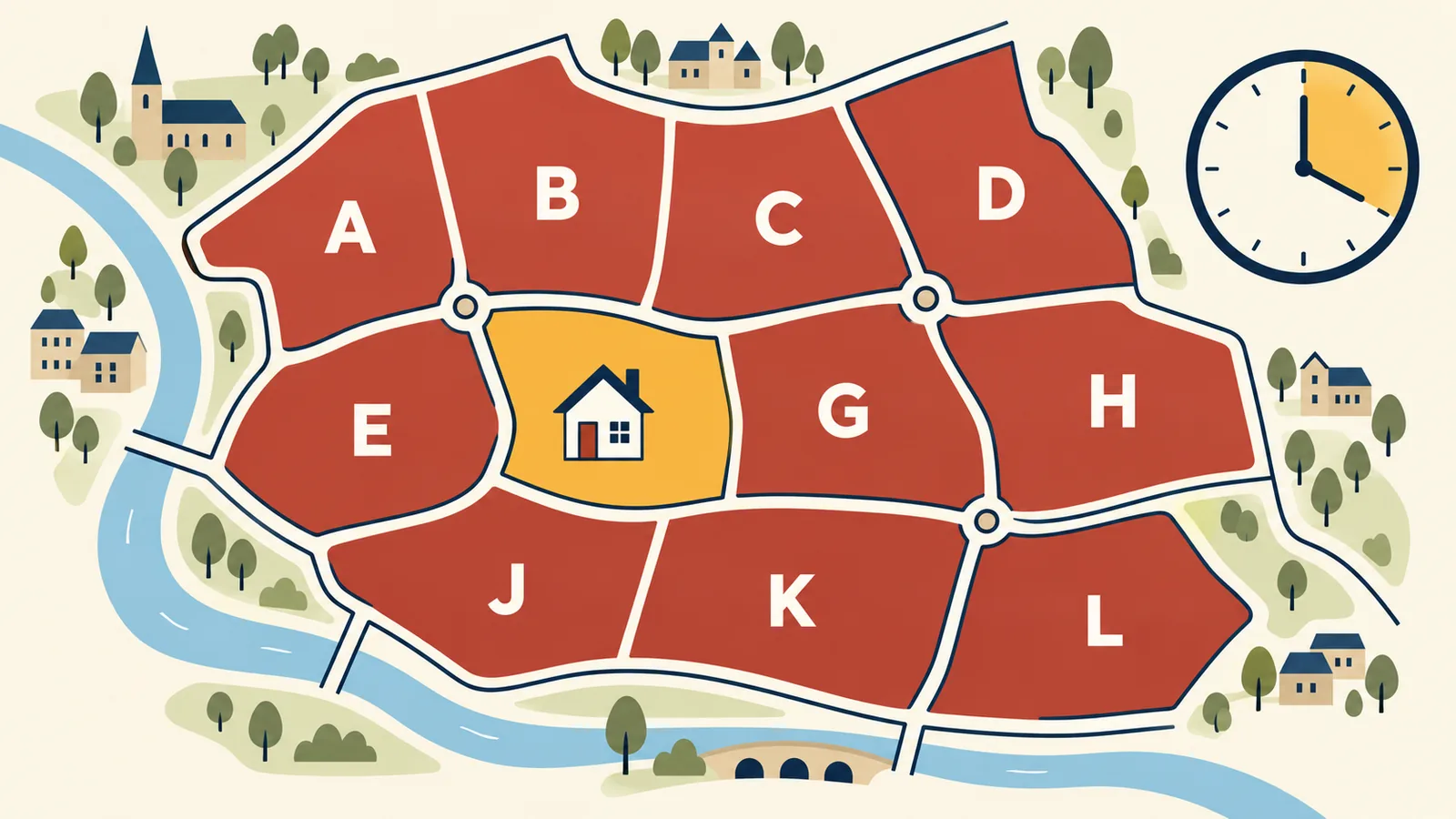
The short answer: your load block letter is a single letter, A to U, that puts your home in one of 18 groups on the electricity network. If Great Britain ever ran seriously short of electricity, those groups would take turns to be switched off for around three hours at a time, so the power available is shared fairly. Find yours by entering your postcode at powercut105.com, or look for a single letter in a small box near the supply address on your electricity bill. Still stuck? Call 105 free (03457 643643 in Northern Ireland).
This is planning, not a prediction. Rota cuts haven’t happened in the UK since the 1970s, and the current early view for winter 2026/27 expects supply to stay secure. Looking up your letter takes less time than boiling the kettle, so do it today and write it down.
What is a rota disconnection?
What does rota disconnection mean?
A rota disconnection is a planned, rotating power cut used as a last resort in a national electricity shortage. Instead of the whole country losing power, groups of homes and businesses take turns to be switched off, each for a nominal three hours, until there is enough electricity again. The industry calls them rota load disconnections.
The rules sit in the Electricity Supply Emergency Code (ESEC), last updated by the Department for Energy Security and Net Zero on 13 April 2026 after a routine review. You may also hear “emergency power cuts” or “power sharing”. Before any rota, the National Energy System Operator (NESO) would try other steps first, such as asking for more generation and paying people to use less at busy times.
Has the UK ever had rota power cuts?
Not since the 1970s, according to UK Power Networks. The closest recent call was winter 2022/23, when the grid’s system operator modelled an unlikely scenario in which rota cuts might be needed. They weren’t: a mild winter and lower demand meant reserves never dropped to the trigger point.
Is a rota likely this winter?
The current outlook is reassuring. NESO’s early view of winter 2026/27 expects the electricity system to remain secure and reliable, with a 5.5GW surplus, an 8.8% buffer over expected peak demand. It says January may be more finely balanced, and a fuller Winter Outlook is due later this year.
What your letter means
What do the letters A to U mean?
They are labels, not rankings. Each network operator’s area is split into 18 load blocks, each carrying roughly 5% of demand, and almost every home or business sits in one. The letters run from A to U but skip F, I and O. No letter is luckier: the rota is designed to share cuts evenly.
| Letters | |
|---|---|
| Used (18) | A, B, C, D, E, G, H, J, K, L, M, N, P, Q, R, S, T, U |
| Not used | F, I, O |
Letters as listed in the ESEC rota plans.
Most people who share your letter share your timetable. How often it comes round depends on the size of the shortfall: the code’s plans run from level 1 to level 18, and at level 1 each letter is off for two to four 3-hour slots a week. Each day has eight slots, starting at 00:30.
Why does my neighbour have a different letter?
Because the letter follows your connection, not your street. Your home is linked to the network through a local substation and cable, and that connection sets your block. Homes on the same street can be fed by different cables, so neighbours can have different letters. Your letter only changes if you move home.
How to find your load block letter
Is my block letter on my electricity bill?
It may be, but not every bill shows it. Look on the front page, near the supply address, for a single letter in a small box. Some suppliers label it “Rota Block Letter”; others leave it unlabelled. The GOV.UK Prepare site says some suppliers include it, so if yours doesn’t, use the postcode checker.
How do I find my block letter by postcode?
Go to powercut105.com, type your postcode into the “Your Postcode” box on the home page and press Find. The results page names your local network operator and shows “Your rota block is” with your letter underneath. The site is run by the Energy Networks Association for Britain’s network operators.
Write the letter on paper next to your emergency numbers, because a power cut can take out internet and possibly mobile signal. SSEN customers can also use its My Rota Block map. No luck either way? Call 105 free.
If you live in Northern Ireland, Scotland or Wales
- Scotland and Wales use the same system as England: look up your letter at powercut105.com and call 105 to report a power cut.
- Northern Ireland has its own arrangements. The system operator, SONI, can instruct NIE Networks to carry out Planned Emergency Power Cuts (once called load shedding), switching blocks of customers off for up to 3 hours. NIE Networks has its own postcode checker on that page, its lookup uses the same 18 letters, and any rota would be published there. Report power cuts on 03457 643643. If someone at home uses medical equipment, join NIE Networks’ Customer Care Register. We could not confirm whether bills in Northern Ireland show the letter, so use the NIE checker.
How would I be told about a rota?
How much warning would I get?
If there’s time to plan, usually the afternoon or evening before. Under ESEC, NESO normally proposes the next day’s rota by 14:00, the government confirms a plan by 15:00, and network operators get the detailed switching schedule by 17:30. Rotas go on powercut105.com once cuts are confirmed, and could be shown up to a week ahead.
Once a rota is running, the postcode checker shows your times for the next day plus “risk” periods after that, so check it each evening. SSEN says it would text customers by 6pm the day before, so keep your mobile number up to date with your supplier. Rumours spread fast online: check powercut105.com before acting on a shared post.
Could the power go off without warning?
Yes, in a sudden shortfall. SSEN and SP Energy Networks say an urgent instruction could come with little or no notice, and texts might arrive after the cut starts. The April 2026 code also describes a same-day protocol for when the industry has at least eight hours’ warning. Treat your letter as a planning aid, not a guarantee.
Protected sites: what they mean for your home
Which sites are protected from rota cuts?
A short list of sites that keep critical services running, such as hospitals with A&E and intensive care, ambulance and fire control rooms, water treatment works and some major transport sites, as set out in ESEC. They stay connected but must still cut their own use. Sites have to apply, and network operators don’t share the list.
Can my home be protected?
No. Homes cannot become protected sites, and households on the Priority Services Register are still included in the rota. UK Power Networks puts it plainly: the protected list does not protect vulnerable customers. That’s why people who rely on electricity for health reasons are asked to make a backup plan now.
A few homes may keep power because they share a cable with a protected site, which ESEC calls associated load, but you can’t apply for it or count on it. Mobile masts and broadband are not protected either.
If a rota is announced: before, during and after
Our power cut guide covers the full routine. These are the rota-specific points.
Before your slot
- Check tomorrow’s times for your letter.
- Charge phones and power banks, then go easy on their batteries until your slot.
- Boil the kettle and fill a flask for hot drinks or a hot water bottle.
- Put a torch within reach. Torches are safer than candles.
- Have food that needs no cooking and warm layers ready. Cuts are most likely around the morning and evening peaks.
The first 10 minutes
- Switch appliances off at the wall except the fridge and freezer, and leave one light on so you know when power returns.
- Keep fridge and freezer doors shut.
- Expect your heating to stop too: a heat pump, gas boiler or gas hob needs electricity, and so do your broadband and home phone.
- Only use other heating, lighting or cooking if it’s safe, and keep a tested carbon monoxide alarm.
If it lasts longer
- Switch times can drift about 30 minutes either side, and ESEC allows up to an hour’s delay for some blocks to come back.
- Still off four hours after it went? Call 105. It may be an ordinary fault.
After
- Check the next day’s times: your letter may come round again.
- Recharge everything and refill the flask.
- There’s no compensation. Ofgem won’t pay out for “blackouts caused by a national power shortage“.
What helps for a three-hour slot
Most of this is on the public GOV.UK Prepare checklist; our emergency kit checklist has the full list.
- Light: a battery or wind-up torch, safer than a candle.
- Phone power: a charged power bank, so a flat phone isn’t your only link.
- News: a battery or wind-up radio, for updates if the internet is down.
- Warmth: blankets and warm layers for evening slots.
- Food and drink: a flask and food that needs no cooking.
We’re putting together an Essentials Kit: the non-food essentials from the Prepare list in one bag, with a card saying exactly which water and tins to add. Join the list to hear when it’s ready.
People who need extra help
- Priority Services Register (PSR): free in England, Scotland and Wales; sign up with your network operator or energy supplier (powercut105.com). It won’t take you off a rota, but network operators must offer registered customers extra help, and SP Energy Networks says it will try to contact customers before a rota starts where it can.
- Medical equipment: speak to your healthcare or equipment provider now about a backup plan, and have backup batteries checked and maintained (powercut105.com).
- Stairlifts: check how long the backup battery lasts. During a scheduled slot, the person needs a ground-floor exit, a phone and heating (SP Electricity North West).
- Telecare: if you use a personal alarm, your phone provider must give you a free backup battery unit so your landline works for at least an hour in a power cut (GOV.UK Prepare).
- Neighbours: check on anyone living alone before their slot and again after it.
Sources
- Energy Networks Association, powercut105.com: home and postcode checker, Find my block letter, Types of power cut
- Department for Energy Security and Net Zero: Electricity Supply Emergency Code, ESEC guidance, April 2026 (PDF), Annex 2 rota plans (spreadsheet)
- GOV.UK Prepare: Power cuts, Get prepared for emergencies, Phone and broadband outages
- NESO: Winter Watch, early view of winter 2026/27, Winter Outlook Report, 6 October 2022 (PDF)
- UK Power Networks: Emergency power cuts, Annual Review 2023: organisational resilience
- SP Energy Networks: Emergency power cuts
- SSEN: Helping you prepare this winter, My Rota Block
- SP Electricity North West: Emergency power cuts FAQs
- National Grid Electricity Distribution: Rota load disconnections
- Ofgem: Check if you can get a payment for a power cut
- NIE Networks: Planned Emergency Power Cuts, Customer Care Register