

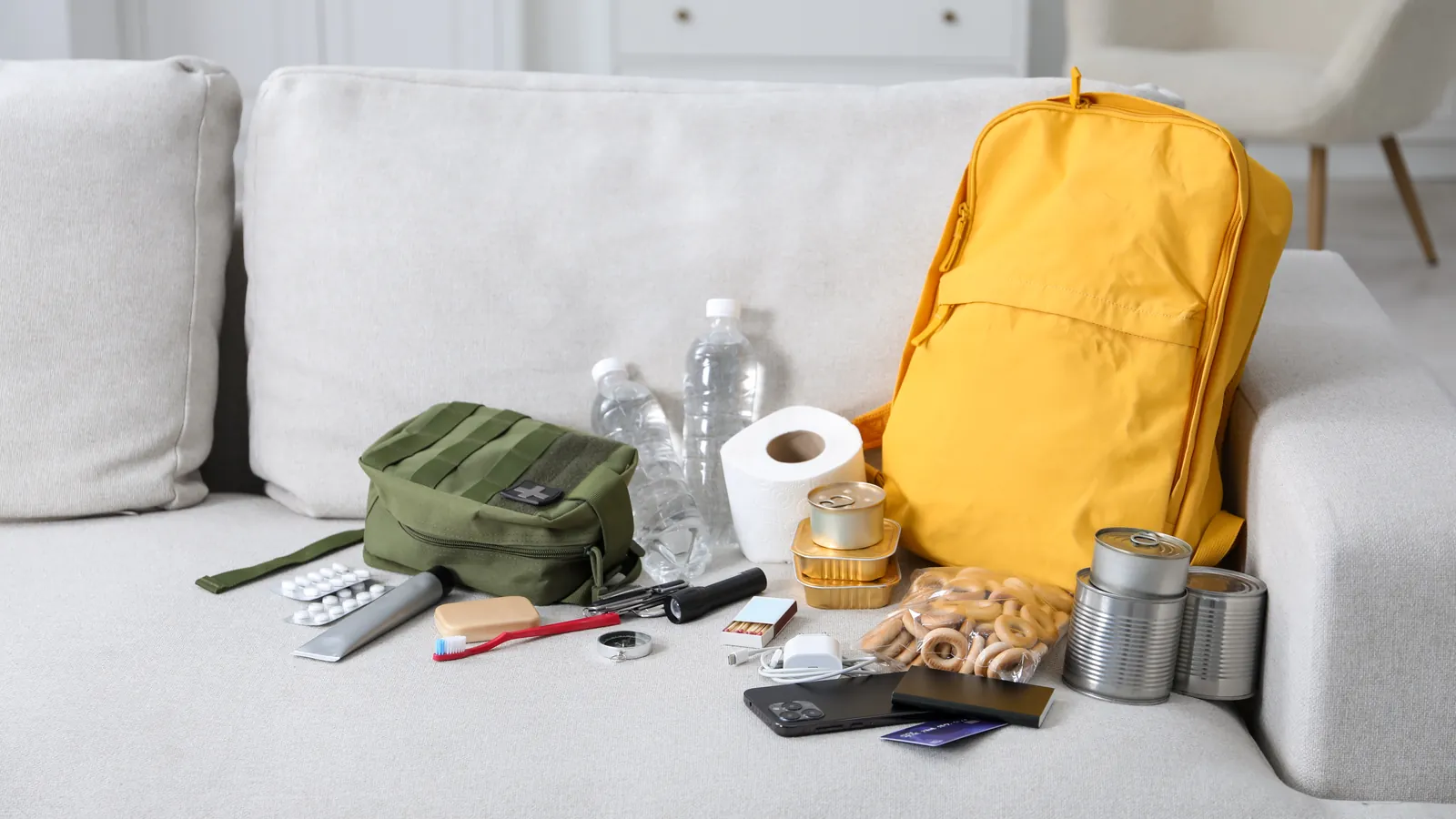
The GOV.UK Prepare website suggests a home emergency kit of nine things: a torch, a power bank, a radio, spare batteries, a first aid kit, hand sanitiser and wet wipes, bottled water, food that doesn’t need cooking (plus a tin opener) and baby supplies. For water, Prepare gives a minimum of 2.5–3 litres per person per day, with 10 litres more comfortable (Prepare). In a power cut, call 105 in England, Scotland and Wales, or 03457 643643 in Northern Ireland (Prepare).
This guide is based on the public GOV.UK Prepare checklist. Below: that list word for word, a water table for your household, and the seven extras we’d add.
In late September 2026, Defence Secretary Wes Streeting asked households to keep some cash, bottled water and tinned food at home, and called for alertness rather than alarm (LADbible, 27 September 2026). It’s a sensible ask, not a reason to panic. Water and tins are already on the Prepare list, and cash is on ours. The aim: ready, not worried.
The Prepare emergency kit list, word for word
Prepare says a home kit “could include” these nine things. The middle column is quoted from the Prepare page.
| # | What Prepare says | Our note |
|---|---|---|
| 1 | “Battery or wind-up torch – torches are safer than candles.” | Keep it where you can find it in the dark. Candles are for birthdays; torches are for power cuts. |
| 2 | “Portable power bank for charging your mobile phone.” | Keep it charged, with its cable. |
| 3 | “Battery or wind-up radio to get updates during a power cut …” | Write down your usual stations’ frequencies (Prepare’s tip). |
| 4 | “Spare batteries for torches and radio and a backup battery for any medical equipment you rely on.” | Check the sizes match. |
| 5 | “A first aid kit (or some first aid items) including items such as waterproof plasters, bandages, a thermometer, antiseptic, eyewash solution, sterile dressings and gloves, medical tape for dressings, and tweezers.” | Ready-made kits vary, so tick yours off against this. |
| 6 | “Hand sanitiser and wet wipes for hygiene purposes when the water is off.” | For when the tap isn’t an option. |
| 7 | “Bottled water” | See the table below. |
| 8 | “Non-perishable food that doesn’t need cooking, such as ready-to-eat tinned meat, fruit or vegetables (and a tin opener).” Prepare adds: “Don’t forget food for pets.” | Make the tin opener a manual one: an electric one won’t help in a power cut. |
| 9 | “Baby supplies such as nappies and baby formula – ready made or ‘ready-to-feed’ formula is best as you may not be able to boil water or sterilise bottles.” | Check nappy sizes as your baby grows. |
How much water do you need?
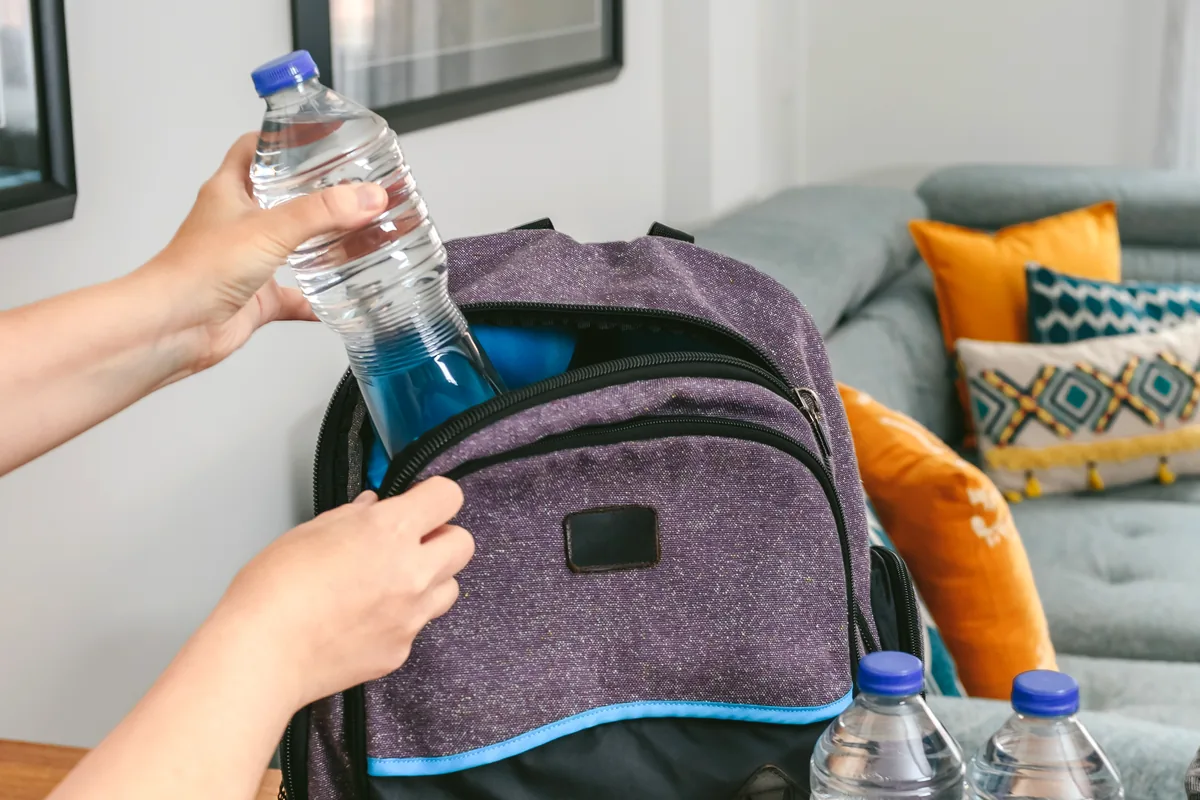
How much water should I store for an emergency in the UK?
Prepare quotes the World Health Organisation’s survival minimum: “2.5-3 litres of drinking water per person per day”. Ten litres a day is more comfortable, because it also covers basic cooking and washing. Prepare doesn’t set a number of days. Ready Scotland and the British Red Cross both suggest three, so the table uses three.
| Who | Minimum per day (2.5–3 L each) | 3 days at the minimum | 3 days at 10 L a day (comfortable) |
|---|---|---|---|
| 1 person | 2.5–3 L | 7.5–9 L | 30 L |
| 2 people | 5–6 L | 15–18 L | 60 L |
| 3 people | 7.5–9 L | 22.5–27 L | 90 L |
| 4 people | 10–12 L | 30–36 L | 120 L |
| 5 people | 12.5–15 L | 37.5–45 L | 150 L |
| Baby on formula | Ready-to-feed formula needs no water to make up | 3 days of ready-to-feed cartons | If you use powder, you’ll need to be able to boil water |
| Pets | No set figure: for dogs, it depends on age, size, activity, diet and health | Measure what your pet drinks on a normal day and keep 3 days of that, on top of yours | Ask your vet if you’re unsure |
Sources: Prepare (which notes extra water may be needed for baby formula, medical devices and pets); Prepare’s power cuts page for formula; Dogs Trust for pets.
Most homes have some way to go. In the government’s 2026 preparedness survey, at 3 litres a person a day, 82% of people surveyed had less than one day’s bottled water at home. Only 4% had three days or more.
An easy start: a pack of six 1.5-litre bottles is 9 litres, which is three days at the minimum for one person.
What we’d add: 7 things beyond the Prepare kit list
These are our suggestions, not part of Prepare’s kit list. Each says where it comes from: a UK public source, or plain common sense.
- Cash in small notes. Card machines and cash machines need power (common sense). The British Red Cross puts cash in its home kit.
- A paper list of phone numbers. If your phone runs flat, your contacts go with it. Prepare’s planning advice says to write numbers on paper (Prepare). Include 105 (03457 643643 in Northern Ireland), 999, NHS 111, the gas emergency line (0800 111 999 in Great Britain, per HSE), your water company (it’s on your bill), GP, family, neighbours, insurer and radio frequencies.
- A written list of your medicines. Anyone helping you can see exactly what you take (common sense). Prepare suggests listing your regular medication, keeping several days’ supply, and a paper copy of instructions for any medical equipment.
- Spare glasses or contact lenses, and hearing aid batteries. An old pair is fine; replacing them in a power cut is not (common sense). Ready Scotland lists these.
- A whistle. It carries further than a voice and takes less breath (common sense). Ready Scotland includes one.
- A warm blanket, or a foil one if space is tight. Boilers and heat pumps won’t work without power, and Prepare suggests blankets and layers to keep warm (Prepare).
- Copies of key documents in a waterproof wallet. If you’re asked to leave quickly, you won’t be hunting for them. Prepare suggests keeping your household plan with passports, birth certificates and insurance policies; Ready Scotland suggests copies in the kit.
Build it gradually: one thing a week
Do I need to buy everything at once?
No. Prepare’s advice is to add things when you can and let the kit grow over time, rather than buying it all in one go. The British Red Cross suggests one item at a time, for example with your weekly shop. At one thing a week, you’ll have the lot in about ten weeks.
| Week | Add this |
|---|---|
| 1 | A bag or box you already own, plus your paper list of numbers and medicines (free) |
| 2 | Torch and spare batteries |
| 3 | Water: one six-pack of 1.5-litre bottles per person |
| 4 | Tins that don’t need cooking, and a manual tin opener |
| 5 | Battery or wind-up radio; write down your local station frequencies |
| 6 | Power bank and cable (charge it) |
| 7 | First aid kit, checked against Prepare’s list |
| 8 | Hand sanitiser and wet wipes; baby and pet supplies if needed |
| 9 | Cash in small notes; copies of documents in a waterproof wallet |
| 10 | Blanket, whistle and spare glasses |
Buy as part of your normal shop. There’s no need to clear a shelf.
Where to keep it (flats and small spaces too)
Where should I keep an emergency kit in a flat?
Keep it all in one place that’s easy to find if the lights aren’t working, as Prepare suggests. In most flats, a hallway cupboard near the front door works well. If space is tight, split the water between under the bed and the bottom of a wardrobe, and keep the paper list with the torch.
- Grab bag. Prepare suggests a spare bag for things you’d need if asked to leave quickly. Keep documents, cash, your medicines list, spare glasses and the power bank in a small bag on top.
- Fire. Prepare is clear: if you’re escaping a fire, take nothing with you. Just get out.
- Flood risk. Ready Scotland suggests keeping some of the kit in a waterproof bag in case you have to leave without notice.
- Renting. Nothing here needs drilling, fixing or permission.
Check it twice a year, when the clocks change
How often should I check my emergency kit?
We suggest twice a year, when the clocks change, because the date is hard to miss. The next changes are Sunday 25 October 2026, when the clocks go back, and Sunday 28 March 2027, when they go forward (GOV.UK). Here’s what to check.
- Water and tins: check the dates. Eat anything close to its date and replace it.
- Power bank: charge it fully.
- Torch and radio: switch them on; swap tired batteries.
- First aid kit: replace anything used or out of date.
- Paper list: update numbers, medicines and radio frequencies.
- Baby and pet supplies: check nappy sizes, formula dates and pet food.
- Smoke alarms: test them too. Prepare suggests checking them at least once a month.
People who need extra help
- Medical equipment that needs power: make a plan now with your care provider or clinical team for a power cut. Keep paper instructions and charged backup batteries (Prepare).
- Priority Services Register: free for people with extra needs. Sign up with your electricity network operator, energy supplier and water company; each keeps its own register (thepsr.co.uk; in Scotland, psrscotland.com).
- Landlines and telecare: if a landline is your only way to call 999, or a telecare alarm runs through it, ask your provider whether it works in a power cut. They might offer a free back-up battery unit or similar, lasting at least an hour (Prepare).
- Neighbours: plan to check on anyone nearby who may need help, especially if the power goes out (Prepare).
- More help: Prepare has a page of advice for disabled people and carers.
If you live in Northern Ireland, Scotland or Wales
- Power cuts: 105 (or powercut105.com) covers England, Scotland and Wales. In Northern Ireland, call NIE Networks on 03457 643643.
- Priority help: the Priority Services Register covers England, Scotland and Wales; Northern Ireland has Customer Care Registers (Prepare).
- Gas emergency: 0800 111 999 in Great Britain; 0800 002 001 in Northern Ireland (Phoenix Energy).
- Flood risk: check by postcode for England, Wales, Scotland and Northern Ireland.
- Scotland: Ready Scotland has its own kit list, with three days of water and food.
We’re putting together an Essentials Kit: the non-food essentials from the Prepare list in one bag, with a card saying exactly which water and tins to add. Join the list to hear when it’s ready.
Sources
- GOV.UK Prepare, Get prepared for emergencies: https://prepare.campaign.gov.uk/get-prepared-for-emergencies/
- GOV.UK Prepare, Power cuts: https://prepare.campaign.gov.uk/be-informed-about-hazards/power-cuts/
- GOV.UK Prepare, Advice for disabled persons and carers: https://prepare.campaign.gov.uk/get-prepared-for-emergencies/advice-for-disabled-persons-and-carers/
- GOV.UK, UK public survey of risk perception, resilience and preparedness 2026 (headline findings): https://www.gov.uk/government/statistics/uk-public-survey-of-risk-perception-resilience-and-preparedness-2026/uk-public-survey-of-risk-perception-resilience-and-preparedness-2026-headline-findings-html
- GOV.UK, When do the clocks change?: https://www.gov.uk/when-do-the-clocks-change
- Ready Scotland, Make an emergency kit: https://ready.campaign.gov.scot/emergency-kit
- British Red Cross, Prepare an emergency kit: https://www.redcross.org.uk/get-help/prepare-for-emergencies/prepare-an-emergency-kit
- LADbible, Defence Secretary Wes Streeting (27 September 2026): https://www.ladbible.com/news/uk-news/defence-secretary-wes-streeting-brits-war-emergency-636564-20260927
- Dogs Trust, How much water should a dog drink?: https://www.dogstrust.org.uk/dog-advice/health-wellbeing/at-home/drinking-water
- NHS, When to use NHS 111: https://www.nhs.uk/nhs-services/urgent-and-emergency-care-services/when-to-use-111/
- HSE, Gas safety and carbon monoxide: https://www.hse.gov.uk/gas/domestic/co.htm
- Phoenix Energy (Northern Ireland gas emergency number): https://phoenixenergyni.com/
- NIE Networks, Power cuts: https://www.nienetworks.co.uk/power-cuts
- Power cut 105 (linked from Prepare’s power cuts page): https://www.powercut105.com/en/
- Priority Services Register: https://www.thepsr.co.uk/ and https://psrscotland.com/
- Flood risk by postcode: https://www.gov.uk/check-long-term-flood-risk, https://naturalresources.wales/flooding/check-your-flood-risk-by-postcode/?lang=en, https://beta.sepa.scot/flooding/flood-maps/, https://www.nidirect.gov.uk/articles/check-risk-flooding-your-area